
Park County Weekly Arrest Log
Every week, the Park County Sheriff's Office posts an official Activity Report. It covers a named stretch of days. It tallies calls for service by category first. Then it summarizes the arrests from that period. For a multi-day blotter view, nothing in the county beats it. Still, it is not a booking ledger. Entries may list an arrest date. They may also give a brief charge description, a release date, and bond or release wording. Do not treat that as a booking sheet. Booking numbers, live custody status, and photographs sit outside the weekly format. Someone named in the PDF could already be out of custody.
Read Park County Arrest Reports
Start with the newest report. Then work backward by the dates printed on each PDF. The publication page and the archive are separate views, so checking both keeps an old report from passing as the latest.
- Open the Sheriff's Activity Report page and note the date span in the report title.
- Read the calls-for-service totals as context, then locate the arrest narratives below them.
- Separate arrest date from release date and bond language. They describe different stages.
- Open the official archive for earlier weeks or occasional combined date ranges.
- Use Citizen RIMS, VINE, or the jail phone for present custody because the weekly PDF is retrospective.
The Park County Activity Report archive lists each dated PDF going back through earlier blotter periods.
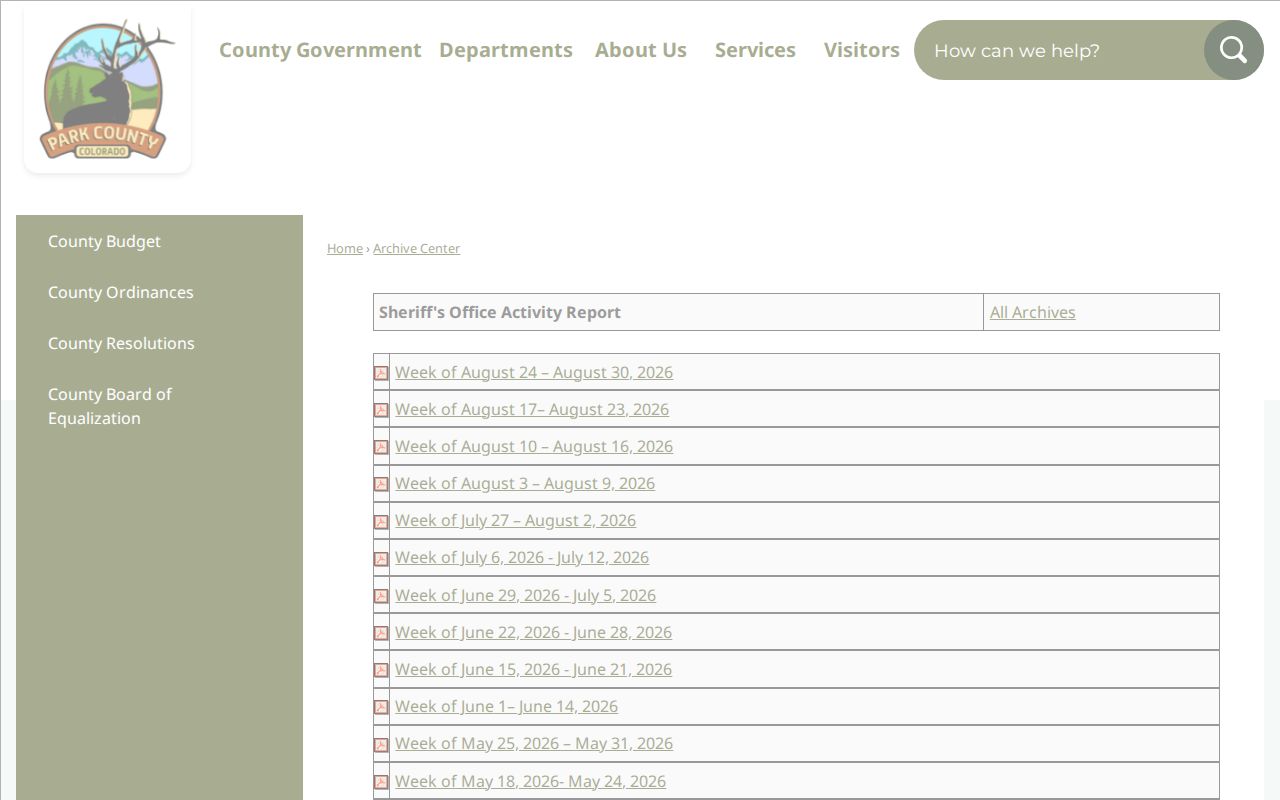
The archive is a solid finding tool. Gaps exist between postings, though, so treat it as a partial run of weeks rather than a complete one.
Park County Log Entry Fields
The weekly narrative is leaner than the live portal. Read each label inside the report's own date span, and resist importing details from an unrelated source.
| Report item | What it answers |
|---|---|
| Named week | The period summarized by that PDF or archive item. |
| Arrest date | The date of the stated arrest, not necessarily the booking time. |
| Charge description | The charge summarized by the Sheriff, not the court disposition. |
| Release date | A reported release event when included, not proof that the court case ended. |
| Bond language | A release condition or status phrase. |
| Calls by category | Weekly service context such as traffic, animal control, motor assistance, welfare checks, or REDDI reports. |
No booking photo appears in the Activity Report. No booking number does either. For an image or a full record, ask the Park County Sheriff's records custodian. For a court outcome, turn to Park County Combined Court.
Park County Weekend Arrest Timing
No source promises weekend, holiday, or exact time-of-day publication in Park County. The Activity Report runs weekly. A booking made late in a period might surface first in Citizen RIMS. A jail check could show it too. It could then land in a later weekly summary if the Sheriff includes it. Some reports combine date spans. Trust the title over any assumed seven-day cycle. For current status, skip the PDF wait. The Park County 24 Hour Arrests page explains the date-filtered Citizen RIMS path. It also shows how to confirm with the jail. The weekly log earns its keep in one case. That is when you are scanning several days of activity around an arrest. Note: A release can happen before publication, so a weekly arrest narrative never proves current detention.
Park County Arrest Log Archives
The county archive holds plenty of current-year reports. Older items sit there too, including some combined periods. The sequence shows gaps. Online persistence is not the Sheriff's legal retention duty. No Park County schedule states how long every booking sheet or photograph is kept.
When a report is missing, send a narrow Colorado Criminal Justice Records Act request to the Park County Sheriff's Office. Include the name, an approximate arrest date, the arresting agency, and any booking or case number. Say whether you want the Activity Report, a booking sheet, a release record, or a photograph. A custodian may review and redact what comes back. The Park County Archives site documents local historical research resources.
That collection shines for old newspaper research. It does not present itself as a modern Sheriff booking-record repository.
Park County Blotter News Context
A 2018 Sheriff archive item described a dispute. It concerned The Flume reproducing the weekly Activity Report as a blotter. That history settles a ranking. When the same event appears in both places, the county PDF leads. The Flume can add reporting, court context, and later developments. No stable arrest-blotter page or mugshot gallery exists there. The local Flume news site can be searched. Look there for reporting tied to a Park County incident.

Treat local news as secondary. It can be incomplete or stale. Verify an arrest with the Sheriff and the final outcome with the court. An unofficial jail directory keeps a Park County page too. It gets no link here. Official sources lead, and no third-party site can vouch for freshness, photo policy, or full county coverage. A missing web item proves nothing. The Sheriff, jail, and court remain the proper sources.
Park County Enforcement Log Context
The Activity Report does more than list Park County arrests. It sits alongside traffic calls, animal control, motor assists, welfare checks, and miscellaneous service requests. REDDI entries also appear, Colorado shorthand for “Report Every Drunk Driver Immediately.” Those call totals measure workload. They do not prove a checkpoint program. They count stops and reports, nothing more. Treat one weekly PDF as a single snapshot. A trend needs a consistent series with clear methods. For Park County recent arrests, name the period, read the Sheriff's summary, then check the live custody or court source.
Park County Records Past Archives
A weekly arrest log PDF is a publication, not the full file. Gaps happen. When the week you need is missing, tell the Sheriff's records custodian. Give the exact record and date range you want. Narrow requests get answered faster. Ask for everything tied to a broad span and the search slows to a crawl.
The source record often holds more than the weekly summary prints. Think booking identifiers, arresting agency, location, or current status. Whether it gets released comes down to Colorado law and the custodian's review. An online gap does not mean the record was destroyed. Don't treat the Colorado model retention schedule as Park County's own. Each sheriff must get approval before adopting it.
Courts run on a separate system. With a booking name and rough date, search the official Park County docket. Look for a matching case. The Combined Court clerk can then supply a disposition or a copy of a document. An arraignment is just an early hearing. A disposition is the final outcome. Neither one comes from the arrest log alone.
Old newspaper collections serve a different purpose. They capture public events from years past and sometimes reprint old reporting. But they can't confirm who is in custody today. Date each source you touch. Compare it against the official agency record. Court material is what settles what happened after the booking stage.
Keep three dates in your notes: the dates a report covered. Note when it was published. And note when you accessed the archive. That trio makes later verification possible once a PDF moves or disappears.